Studio Art Honors II & III
  • Current Assignments
  • Course Expectations
  • Galleries
  • Resources
  • Burlington High School Art & Design Program

Gouache on Watercolor Painting

2/26/2020

0 Comments

 
​Complete your watercolor illustration by using gouache to add texture, detail, and additional design elements to the broad colors of your watercolor. Consider the work of Georges Seurat, Gustav Klimt, and Vincent Van Gogh as possible approaches.

We will evaluate this on: personal investment and studio habits of mind (thinking like an artist, experimenting, taking thoughtful creative risks), aesthetics/design (particularly strength of color relationships), and technical quality (craftsmanship with the painting medium, level of detail and refinement).
0 Comments

Watercolor Illustration

2/13/2020

0 Comments

 
Referencing your value drawing illustration of a fable, myth, or fairy tale, and using what you learned about color theory, paint a full-color illustration in watercolor.

This must be a specific scene from the story that includes:
  • interacting figures (i.e. people and/or animal characters)
  • environment
  • depth
  • the indication of a light source

Parameters:
  • Size: 9 x 12" or 11 x 14"
  • Medium: watercolor on watercolor paper

 Grading Criteria: 
  • Improvement of composition from original draft
  • Expressiveness
  • Narrative Qualities / Clarity of Illustration (tells what's happening)
  • Sense of Light
    • Chiaroscuro - light's effect on form
    • Light's effect on color (for example, warm light, cool shadows)
    • Visual drama created by light and shadow
  • Sense of Depth
    • Atmospheric perspective through color shifts (intensity/saturation, temperature changes)
  • Composition / Design/ Visual Impact
    • Unity/harmony through color
    • Variety
  • Craftsmanship/Technical Quality - Detail and Refinement; Range of Values

    Studio Habits of Mind Rubric


To Start:
  1. View/study the work of picture book illustrators such as those below. Pay attention to their differences in style, and to how they have used color to direct your attention to certain areas, to create a sense of atmosphere and space, and to create mood. Notice how they've used the watercolor medium to give a sense of light, and to create different effects.
  2. Create 2 - 3 color studies based on your rough draft, and considering the color theory concepts you've learned about.
  3. Trace your draft onto watercolor paper using a light table, adjusting your drawing as necessary to improve the composition and add details. Use a very light pencil line.
​
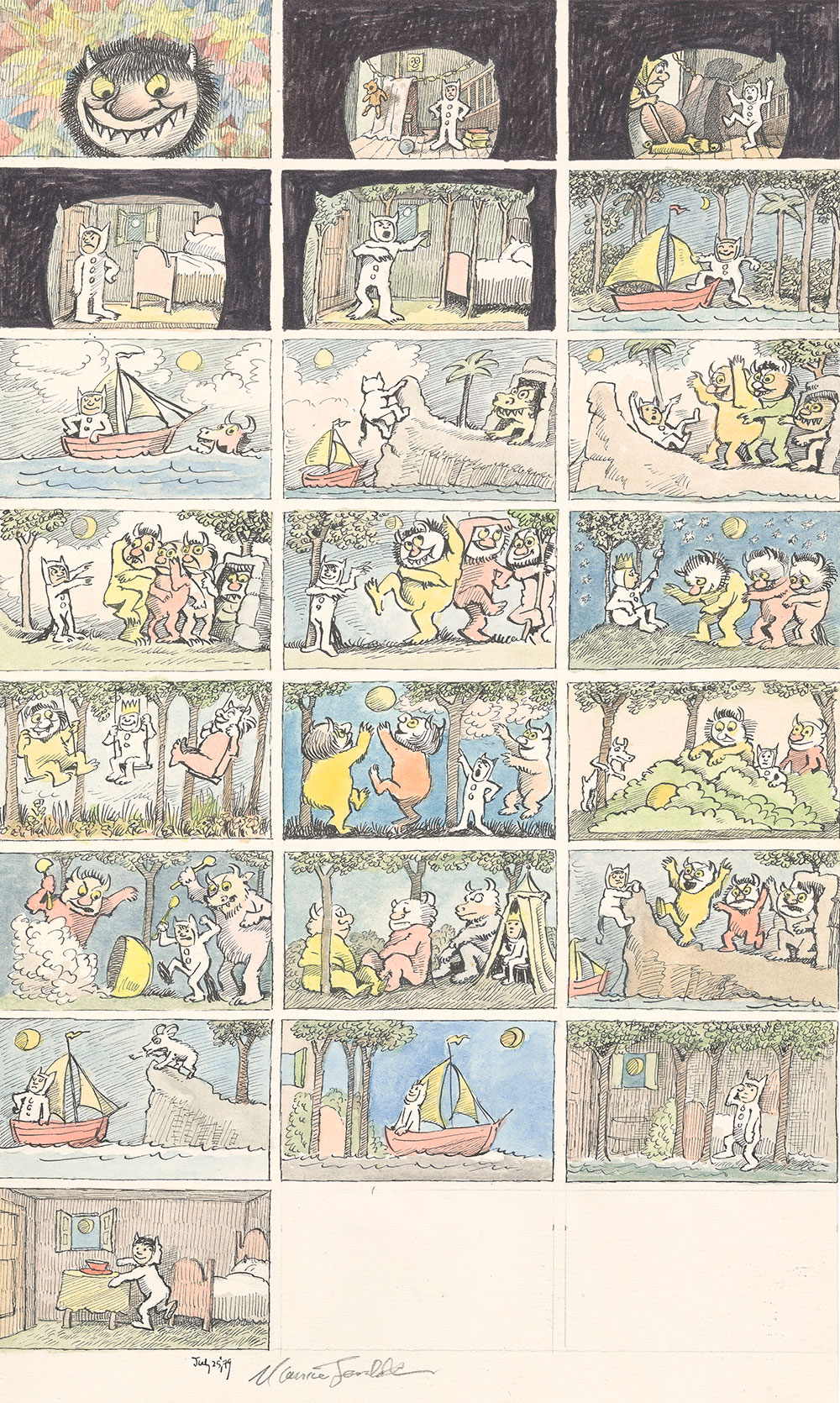
Color thumbnails by Maurice Sendak for Where the Wild Things Are:
Picture
Watercolor illustrations by Maurice Sendak:

​Watercolor illustrations by Jan Brett:

​Watercolor illustrations by Jerry Pinkney:

Watercolor illustrations by Helen Oxenbury:

Watercolor illustrations by Quentin Blake:

Watercolor illustrations by William Steig:
0 Comments

Watercolor Exercises

2/10/2020

0 Comments

 
Picture
Medium: Watercolor on watercolor paper

Objectives:
  • Learn to control the watercolor medium to mix a wide range of specific colors.
  • Develop skill with watercolor to paint both larger areas and small details.
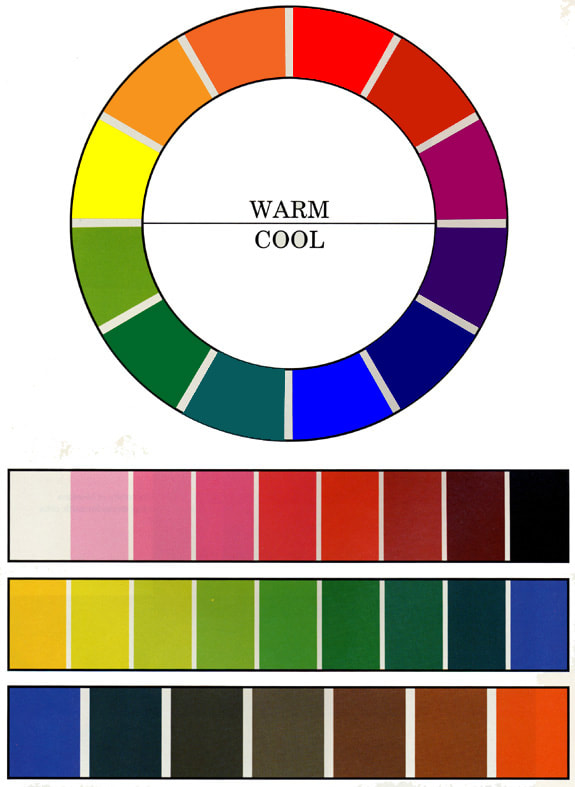
  • Create depth using atmospheric perspective through color shifts -- More vibrant, and usually warmer, as the objects are closer to you; less saturated, less intense, and cooler as they move away.
  • Learn to paint gradations/transitions of color
  • ​Experiment with the medium

Steps: 

1. On a piece of 6 x 9" watercolor paper, experiment with different mark-making using watercolor. First, create a drawing of light pencil line that is composed of closed organic and geometric shapes. Then, paint the design using watercolor so that it includes:
  • Lines, both thin and broad
  • Points, dashes, and other marks
  • Washes
  • Pale colors
  • Intense colors
  • Gradations of dark to light
  • Gradations of one color changing to another

2. Scales: On a strip of 2” x 12” strip of watercolor paper, measure two rows of 1” x 1” squares.
  • Value Scale: In the first series of 5 boxes, paint a sequence of values of a single color (straight from the tube), from very light to very dark, in perfectly equal increments.
  • Value Scale with mixed color: In the next series of 5 boxes, paint a sequence of values of a single color that you have mixed (i.e. NOT straight out of the tube, a reddish brown, for example), from very light to very dark, in perfectly equal increments, while maintaining its hue.
  • Intensity Scale: Starting with complementary colors at the far ends of the next set of 5 boxes, slowly mix a little of one into the other as you make your way to the middle, so that the middle box is a perfectly neutral color.
  • Temperature Scale: In the final series of 5 boxes, place a hue in the middle box, then make it gradually warmer as you move in one direction, and gradually cooler as you move in the other direction. Scale from a warm light version of a color (Add yellow and more water) to a cool dark version of a color (add blue). (Example, a light yellow-green transitioning to a dark blue-green).

3. Make a grid of thirty 1” squares on a piece of 5 x 6" watercolor paper, and mix to match the colors of a master painting of your choice (from the reproductions in the classroom). Control the medium to match the hue, temperature, and intensity of thirty different colors in the master painting.
0 Comments

Art Fellows Homework: Full-Value Composition of Fairy Tale

2/6/2020

0 Comments

 
First as thumbnail sketches (at least 3 thumbnail compositions), then as a full-size drawing with a full range of values, develop a composition that illustrates a specific scene from a fairy tale, folk tale, or myth. This is to be completely original, in your own style (not Disney, etc.).

This must be a specific scene from the story that includes:
  • interacting figures (i.e. people and/or animal characters)
  • environment
  • depth
  • the indication of a light source

This drawing will be used as the basis for a watercolor painting in class.

Turn in the thumbnail sketches (at least 3) and the full-sized drawing.

Parameters:
  • Size: 9 x 12" or 11 x 14" (sketchbook-sized)
  • Medium: Collage: graphite (pencil) on paper

 Grading Criteria: 
  • Expressiveness
  • Narrative Qualities / Clarity of Illustration (tells what's happening)
  • Sense of Light
  • Sense of Depth
  • Composition / Design/ Visual Impact
  • Craftsmanship/Technical Quality - Detail and Refinement; Range of Values
0 Comments

Art Fellows Homework: Extreme Nursery Rhyme

2/3/2020

0 Comments

 
First as a drawing, then completed as a cut-magazine-color collage, illustrate a nursery rhyme or fairy tale, but make it EXTREME/exaggerated: exaggerated action, exaggerated emotions. 

The scene must have:
  • action/movement (using angles)
  • depth
  • emotion
  • exaggeration
  • energetic design of the entire page

Parameters:
  • Size: 9 x 12" or 11 x 14" (sketchbook-sized)
  • Medium: Collage: Color pieces clipped from magazines, on heavy paper

 Grading Criteria: 
  • Sense of Movement
  • Emotion / Expressiveness
  • Exaggeration
  • Sense of Depth
  • Design/ Visual Impact
  • Craftsmanship/Technical Quality
0 Comments

    Mr. Ratkevich

    781.273.7024
    [email protected]

    Archives

    December 2022
    November 2022
    October 2022
    September 2022
    August 2022
    March 2022
    February 2022
    January 2022
    December 2021
    November 2021
    October 2021
    September 2021
    June 2021
    May 2021
    March 2021
    February 2021
    January 2021
    December 2020
    November 2020
    October 2020
    February 2020
    January 2020
    November 2019
    October 2019
    September 2019
    August 2019
    June 2019
    May 2019
    March 2019
    February 2019
    January 2019
    December 2018
    September 2018
    March 2018
    February 2018
    January 2018
    November 2017
    October 2017
    September 2017
    April 2017
    February 2017
    November 2016
    October 2016
    June 2016
    May 2016
    April 2016
    March 2016
    January 2016
    December 2015
    October 2015
    September 2015
    August 2015
    June 2015
    May 2015
    March 2015
    February 2015

    Categories

    All

    RSS Feed

Powered by Create your own unique website with customizable templates.